
By Mau Kwok Lam
Introduction: The "Safety Assessment" at the Church Door
"Do they even let… people like you… in?"
This was the first question asked by Madelyn, the highly supportive sister of transgender theologian Austen Hartke[^1], when he was preparing to apply to seminary. The question carried no malice, yet it laid bare a brutal reality: for LGBTQ+ and gender-diverse Christians, "church" has never been a space they can walk into unconditionally and feel safe.
Have you ever had this experience? Before stepping through the doors of a church, you must stop at the street corner and take a deep breath.
You need to wipe your sweaty palms, adjust your clothes, and quickly boot up a series of mental defense mechanisms: Is my attire conformed enough to their gender expectations? What if the sermon condemns homosexuality? Which restroom do I use so as not to cause panic?
This "hypervigilance"—almost a survival instinct—is a self-defense mechanism forged by countless queer Christians through years of neglect, exclusion, and subtle hostility. Faith is meant to be a sanctuary where "there is no fear in love" (1 John 4:18), but in reality, entering a church often becomes a high-stakes psychological battle.
Modern conservative churches continue to erect high walls in politics and dogma under the banner of "protecting religious liberty." Yet, when the sanctuary becomes a battleground, where do wounded souls go? By connecting Austen Hartke’s insights in Transforming[^1] with the lived realities of Chinese queer Christians, we seek a way back to the biblical refuge where bulletproof vests are no longer required.
I. Weighing Risks at the Temple Gates: The "Invisible Bulletproof Vest" of Chinese Queer Believers
In Chinese church contexts—highly characterized by "face culture" (面子文化), "filial/family harmony" (家庭和諧), and "submission to authority" (順服權威)—the hostility queer believers experience is rarely an overt, dramatic expulsion. Instead, it is a refined, suffocating form of invisible oppression. To remain within their faith and family communities, they must don an "invisible bulletproof vest" and navigate each Sunday in a state of tense hypervigilance.
1. Ming-hao in Taiwan: The Restroom Battle on the Gender Divide
Ming-hao (pseudonym)[^2][^3] is a transgender man raised in Taiwan who has undergone gender-affirming surgery. His parents are senior lay leaders in their traditional church. To save his parents' "face" and standing in the community, Ming-hao's transition remains an unspoken secret at home.
Every Sunday is an ordeal for Ming-hao. The church space is heavily structured around strict gender binaries: the brothers' fellowship, the sisters' union, male ensembles, and female choirs. When the service ends and the congregation heads toward the restrooms, Ming-hao’s private battle begins.
- The Double-Bind Abyss: If he enters the men's room, he faces the constant risk of being recognized by elders who have known him since childhood, which could trigger a public outing and family scandal. If he enters the women's room, his masculine appearance inevitably causes alarm and complaints from the sisters.
- Forced Marginalization: To bypass this dilemma, Ming-hao avoids drinking any water for three hours before service. If he absolutely must go, he has to walk to a convenience store two blocks away from the church.
"Every time I step into the sanctuary, I have to keep my voice down and avoid eye contact with anyone," Ming-hao shares. "I feel like a spy lurking in my own home, constantly calculating the risk of exposure. Church should be the place where we meet God, but all I see is a room full of potential landmines."
2. Yan-ting in Hong Kong: "Gentle Surveillance" in the Panopticon
Yan-ting (pseudonym)[^2][^4] was once a key guitarist and worship leader in a medium-sized evangelical church in Hong Kong. When the news of her relationship with her girlfriend spread within the church, she was not expelled outright. Instead, she underwent a years-long process of "gentle dismantlement."
The pastor and small group leader pulled her aside for a "chat," speaking in a deeply tender, sorrowful tone: "Yan-ting, we know you’ve been struggling lately. Serving on stage carries too much pressure. For your spiritual health, we suggest you temporarily step down, rest, and focus on seeking healing."
- The Invisible Panopticon: Yan-ting was removed from the worship stage but placed under constant, suffocating "loving monitoring." Group members would regularly "check in" to see whom she sat next to, monitor what she posted on social media, and even privately question her if she cut her hair short, asking if she was "making a statement about her identity."
- Somatic Trauma Memory: This tight, inescapable scrutiny eventually triggered severe clinical anxiety. Every Sunday morning, looking at herself in the mirror, she would uncontrollably dry-heave and experience shortness of breath.
"They never yelled at me; they just castrated my agency with 'love,'" Yan-ting recalls. "Every time I walked into church, I had to take several deep breaths at the door, telling myself it was just a stage play. My invisible bulletproof vest was pretending to be a repentant sinner trying to overcome homosexual temptation. But that wasn't me—that was my corpse."
II. Systemic Minority Stress: When "Protecting Religious Liberty" Becomes a Privilege to Harm
Hartke notes in Transforming[^1] that these personal traumas do not exist in a vacuum; they are systematically manufactured by powerful religious and political institutions.
In the United States, conservative powerhouses like the Alliance Defending Freedom (ADF), the Family Research Council (FRC), and Focus on the Family have channeled millions of dollars into pushing exclusionary legislation (such as North Carolina's House Bill 2[^5], which barred trans people from using restrooms matching their gender identity). They frame these actions as protecting "religious freedom" and defending "traditional family values."
In Chinese societies, we see a localized replication of this same "fear mobilization":
- Many conservative Chinese ministries import outdated Western ex-gay theories, rebranding them as "life renewal ministries" to foster moral panic about queer believers within congregations.
- Whenever anti-discrimination legislation or marriage equality is proposed, some churches mobilize their members, claiming that their "family values" are under attack and declaring from the pulpit that "the secular world is persecuting Christians."
This narrative, which pits LGBTQ+ human rights against religious freedom, exacts a devastating toll on human lives. Hartke[^1] cites research showing that 41% of transgender individuals have attempted suicide, a figure that jumps to 59% among those harassed at work and 78% among those who have experienced physical or sexual violence.
Modern psychology attributes this to "Minority Stress"[^6]—the chronic psychological trauma accumulated by marginalized groups who constantly live in a hostile environment where rejection is a daily expectation.
When churches demonize queer communities from the pulpit and strip them of membership and dignity in practice, they are actively manufacturing this minority stress. Those queer believers who fearfully cross the church threshold in search of God’s love do not encounter grace; they collide with a system of hostility targeted directly at them.
The church must face this reality: when we insist on enforcing dogmas and practices that we know lead to brokenness, depression, and suicide under the banner of "holiness" and "tradition," we are not defending God's truth. We are manufacturing spiritual refugees.
III. Subverting the Gatekeeper Logic: From "Defensive Fortress" to "Sanctuary"
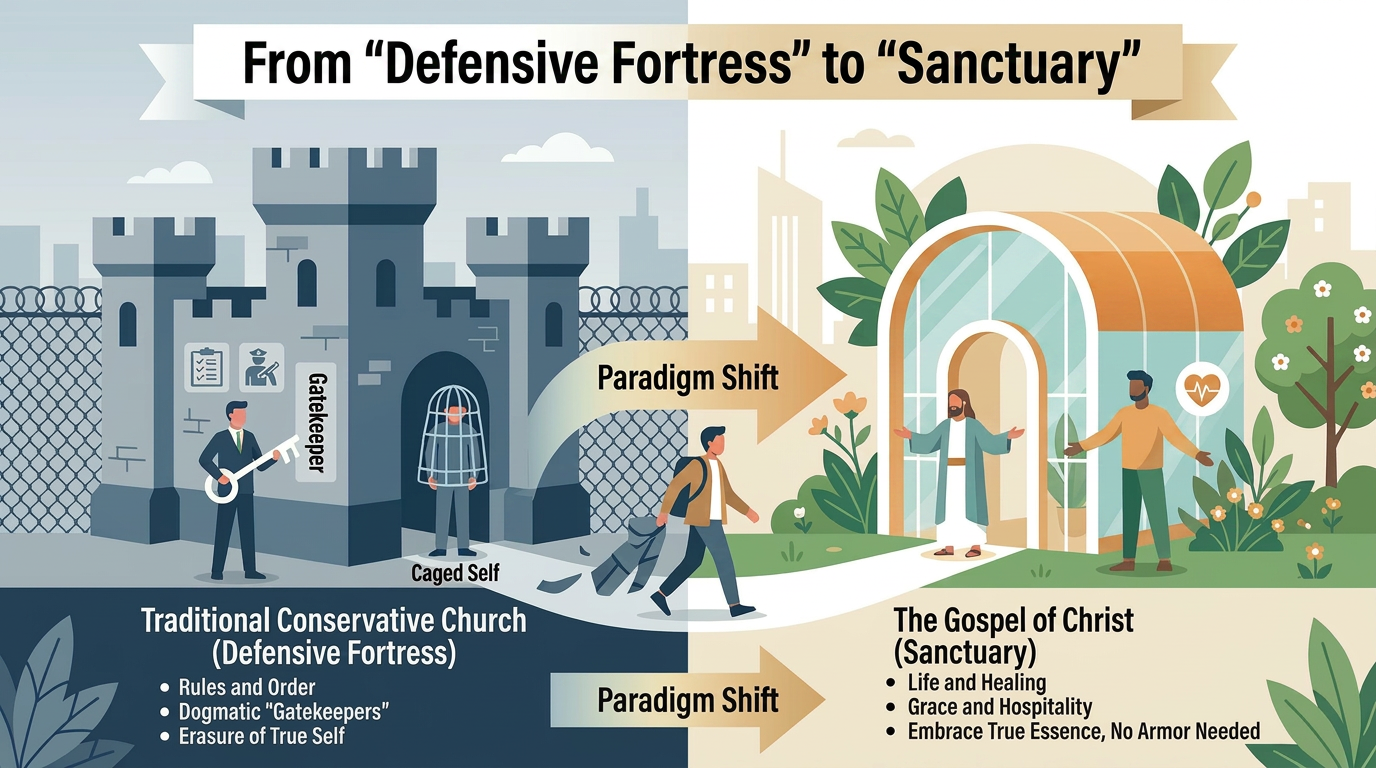
When a church packages itself as a pure fortress that must be defended at all costs, it departs from the Gospel of Christ and downgrades itself to a "Defensive Fortress" .
To reconstruct this space, we must return to the biblical origin of "refuge."
This represents a theological paradigm shift from a "Defensive Fortress" to a "Sanctuary": traditional conservative churches often fashion themselves into a "Defensive Fortress," where operations center on rules and order, and dogmatic "gatekeepers" stand at the door, demanding that queer believers erase their true selves and conform to dogmatic expectations to gain acceptance. In contrast, the "Sanctuary" revealed by the Gospel of Christ is centered on "life and healing." It emphasizes "grace and hospitality," embracing believers in their true essence and making it unnecessary for them to wear bulletproof vests.
1. The Old Testament "Cities of Refuge": An Unconditional Sanctuary of Safety
In the Old Testament, God commanded Israel to establish six "Cities of Refuge" in the Promised Land (Joshua 20:1-9).
- These cities were established for accidental manslayers fleeing the wrath of blood avengers.
- The logic of the City of Refuge was remarkably simple: the fugitive only had to cross the city gates and explain their situation, and they must be accepted and protected. Within the city walls, the avenger could not touch them.
- The City of Refuge did not audit the fugitive's moral perfection or social status; its sole metric was survival and safety. Once they crossed that boundary, God's absolute sovereignty became their shield.
If the Old Testament law itself knew how to establish unconditional physical sanctuaries for chased fugitives, why has the modern church, built in the name of Christ, become an "Avengers' Assembly"—chasing, shaming, and driving queer believers to the brink of death?
2. Jesus’s Boundary-Crossing Hospitality: Actively Dismantling the Gate
Jesus's incarnation completely overturned the gatekeeper logic of the temple.
- The temple of His day had rigid defense mechanisms: Gentiles were excluded, while eunuchs, lepers, and those suffering from hemorrhages were deemed unclean and kept outside the gates.
- But Jesus walked out of the temple courts and into the midst of these excluded people. He touched the unclean leper and dined with tax collectors and sinners. He did not say to the outcasts at the gate, "You must first fix your 'problems' before I let you in." Instead, he stepped out to meet them, saying, "Come to me, all you who are weary, and I will give you rest." (Matthew 11:28)
When churches establish dogmatic audits at the door, demanding that queer believers erase their true gender or relationships to enter, they are acting as gatekeepers. But Jesus never called us to be security guards of the temple; He called us to be stewards of the Kingdom, and that Kingdom is meant to be a "house of prayer for all nations" (Isaiah 56:7).
During His earthly ministry, Jesus always actively broke down the boundaries of clean and unclean, reaching out to touch the marginalized lepers and dining with condemned tax collectors and sinners—He demonstrated through His actions that God's hospitality never presupposes an audit. In such a sanctuary, "perfect love drives out fear" (1 John 4:18); believers no longer need to wear disguises to defend themselves from harm, but can safely lay down their heavy armor and find true spiritual rest in Christ's embrace.
Conclusion: Lay Down Your Bulletproof Vest in Fearless Love
Let us return to the deep breath at the street corner.
What Christ promised was never a rigid, defensive fortress that requires you to wear a bulletproof vest just to enter. He promised green pastures (Psalm 23:2) where the weary can rest, the wounded can weep, and the true self can be tenderly held.
Ming-hao's dehydration, Yan-ting's dry-heaving, and the anxiety of Austen's sister all pose a critical question to the modern church: Will we continue to worship the defensive fortress built of dogma and prejudice, or will we yield to the Spirit and restore the church as a sanctuary of grace?
Every queer believer is a cherished child of God.
Dear queer believer, if you still find yourself taking a deep breath before entering a church, know this: your hypervigilance is not your sin; it is a badge of your resilient soul. But remember even more that the Christ who stretched out His arms on the cross does not ask you to wear a disguised bulletproof vest to meet Him. He knows your true self, He loves your authenticity, and He stands with you outside the gate, calling for a truly free, fearless Kingdom to descend.
Further Reading and References:
[^1]: Austen Hartke, Transforming: The Bible and the Lives of Transgender Christians, (Westminster John Knox Press, 2018), Chapter 1.
[^2]: Note: The Chinese queer Christian cases "Ming-hao" and "Yan-ting" cited in this article are anonymized composite cases created based on the collective lived experiences of real interviewees documented in Tong-Kwang Presbyterian Church's member histories and the qualitative/quantitative studies on conversion practices by the Society of True Light, in order to protect privacy while accurately illustrating the real spiritual and psychological struggles of Chinese queer believers.
[^3]: Tong-Kwang Light House Presbyterian Church, The Lighthouse in the Dark Night: The Faith Journey of Tong-Kwang Presbyterian Church, (Taipei: Yako Press, 2001). Official Website: https://www.tkchurch.org
[^4]: Society of True Light (真光社), Research Report on Sexual Orientation Change Efforts (SOCE) in Hong Kong (2022) & LGBTQ+ Community Mental Health Report. Official Website & Research Portal: https://true-light.asia
[^5]: Jody L. Herman, "Gendered Restrooms and Minority Stress: The Experiences of Transgender and Gender Non-Conforming People in Washington, D.C.," Journal of Public Management & Social Policy (2013).
[^6]: Ilana Meyer, "Prejudice, Social Stress, and Mental Health in Lesbian, Gay, and Bisexual Populations: Conceptual Issues and Research Evidence," Psychological Bulletin 129, no. 5 (2003): 674-697.